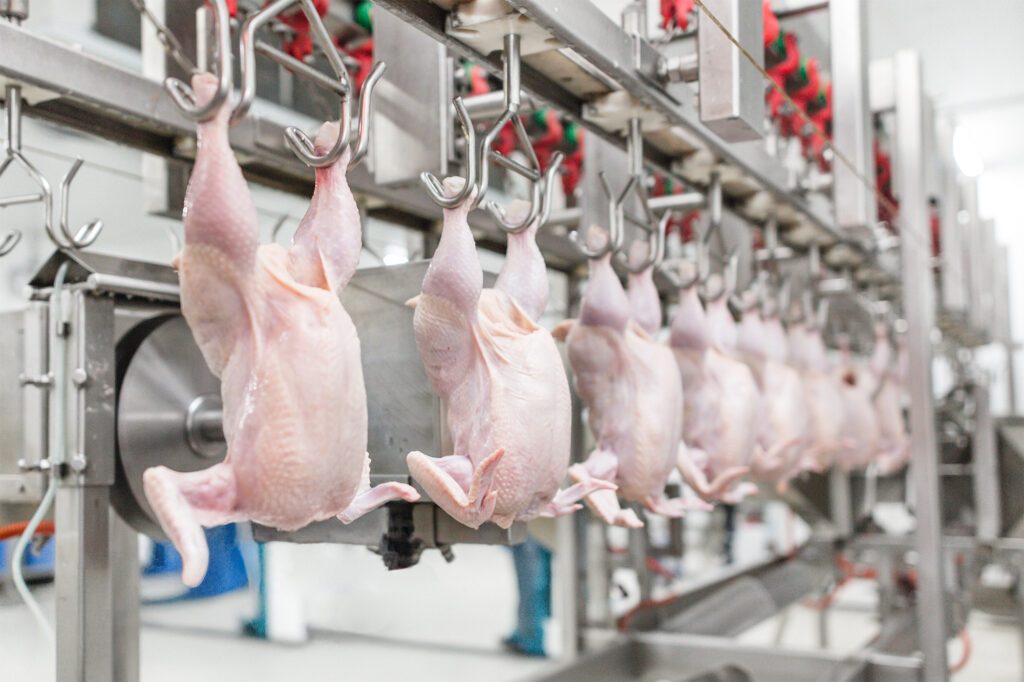
Modern poultry lines move at extraordinary speeds — up to 175 birds per minute under USDA regulations. At that pace, ensuring every carcass is free of foreign objects and quality defects presents a fundamental challenge: human inspectors cannot physically examine each bird thoroughly enough to catch every problem.
The consequences of missed defects are severe. Foreign material contamination triggers costly recalls, regulatory enforcement, and lasting damage to customer relationships. Quality defects lead to downgrades, rework, and waste that erode already-thin margins.
This guide examines why manual inspection falls short at high line speeds, how automated vision systems overcome those limits, and what processors should weigh when implementing detection technology.
Speed vs. scrutiny
Food safety challenges at modern line speeds.
USDA rules permit young-chicken lines to run up to 175 birds per minute. At that rate, each carcass passes an inspection station in roughly a third of a second — and in that fraction, inspectors are expected to identify:
- Foreign materials — metal, plastic, wood splinters
- Broken bones and fractures
- Bruising and discoloration
- Cuts, tears, and skin damage
- Fecal or bile contamination
- Equipment damage marks
The volume is staggering. A single line at maximum speed processes 10,500 birds an hour — 84,000 individual carcasses over an eight-hour shift. Production technology has outpaced inspection methodology, forcing a choice between maximizing efficiency and ensuring food-safety compliance.
Recalls, enforcement, and thin margins.
The financial impact is substantial: industry research puts a recall of fewer than 250,000 units at more than $2 million for a mid-sized food company — even with no illnesses. In Q2 of fiscal 2025 alone, FSIS documented 24,468 noncompliances across meat and poultry establishments during nearly 2 million verification procedures.
Beyond enforcement, reputational damage from foreign-material recalls erodes customer relationships and market position. In an industry running on 2–5% margins, those disruptions directly threaten profitability.
This speed creates a fundamental mismatch: production technology has advanced faster than inspection methodology.
Why manual inspection can't keep up
The math is unforgiving.
At 175 birds per minute, an inspector working a 30-minute rotation faces 5,250 carcasses. Thorough inspection of each for multiple defect types, while maintaining focus and accuracy, is impossible at that volume. Fatigue compounds it — sustained-attention research shows accuracy degrades sharply during extended visual assessment, and cold, humid, fast-paced plants accelerate the decline.
Coverage is another gap. Inspectors typically see each carcass from a single angle; rotating every bird for full-surface inspection would mean slowing the line. Subjective judgment varies across inspectors, shifts, and facilities — and constant workforce turnover means new hires need weeks or months to reach proficiency, with lower detection rates in between.
Poultry processors need a system that inspects 100% of products, at full line speed, with objective and traceable results.
How automated vision works
Capture, analyze, decide, act — in milliseconds.
Modern vision systems combine high-speed cameras, specialized lighting, and machine-learning models to inspect products in real time without slowing production. The workflow runs in milliseconds:
- Capture — high-resolution cameras image each carcass from multiple angles; specialized lighting removes shadows.
- Analyze — models trained on millions of images flag foreign objects, bone fragments, bruising, and contamination.
- Decide — findings are compared against your thresholds and specs for an accept/reject call.
- Act — failed products divert to rejection bins; every event is logged for traceability.
- Learn — detection models refine continuously as more product runs.
Detection built for what humans miss.
Vision systems catch non-metallic foreign materials that metal detectors miss — plastic, wood, rubber — by color, texture, shape, and reflectivity. Multi-spectral imaging surfaces bone fragments beneath the skin. Objective criteria catch subtle bruising and early discoloration every time, and contamination is flagged regardless of line speed, shift, or fatigue.
Implementing it
Assessment, installation, calibration.
Successful rollout starts with understanding your line configuration, your highest-cost defect types, your typical and peak speeds, and how the system will integrate with existing controls and data. Work with providers proven in poultry — moisture, temperature swings, organic material, and washdown demand specialized equipment design.
Installation requires stable, vibration-isolated mounting, consistent shadow-free lighting, clear multi-angle views, and minimal interference from steam or cleaning residue. Initial calibration trains the models on your specific products and standards over several days, and operators and maintenance teams need training on monitoring, thresholds, and sanitation-safe cleaning.
ROI snapshot
Payback in 3–6 months for high-volume lines.
For operations processing millions of birds annually, compact sensors like FloVision Nano mount to existing conveyors and scan 100% of product at line speed. Payback typically lands in 3–6 months — and avoiding a single foreign-material recall, which can exceed $2 million, can cover the investment several times over.
Beyond direct returns: consistent standards across every shift, comprehensive traceability for rapid recall response, and data that pinpoints root causes before they reach customers.